
7th Grade US History Review Bingo Cards - Print Free or Customize
Print free 7th Grade US History Review bingo cards or modify, limitless prints! Pick from 41,500+ templates or use our bingo card generator. Add numbers, phrases, pictures, or all of them. Play using printable PDF, digital bingo cards, and our digital bingo caller, or combine all formats.
About: This bingo card brings history to life, focusing on the dramatic events, influential leaders, and pivotal movements that shaped early America through Reconstruction. It’s perfect for classroom reviews, history clubs, or trivia nights—anywhere you want to spark conversation and curiosity among students or American history buffs. Expect a mix of well-known facts and surprising details for engaging play.
How To: To get a PDF to print, click the Print button. You can adjust the card count and other printing preferences on the Print tab. Grid items and free space text can be added on the Basic tab. Appearance can be highly personalized on the corresponding tabs, or you can easily find any setting on the 🔍 tab.
How to play 7th Grade US History Review Bingo Cards?
- Digital Players: Click on the Play button above, and then click on the 🎫 button.
- Digital Caller: Click on the Play button above.
- Paper Caller: Print PDF calling list & calling slips and manually pick the slips.
- Paper Players: Print PDF bingo cards and manually mark the cards.
- Combo Mode: Pick any combination above. For example, caller can be either Offline or Digital. And players can be Offline or Digital or a combination of both.
Step-By-Step:
- Start by getting the 7th Grade US History Review PDF by clicking on the "Print" button above.
- Open the PDF and print it.
- For random drawing, you can print another copy of the call list, cut, fold and then pick them randomly at play time.
- Cut the bingo cards at the cut marks if there are greater than 1 bingo cards per page.
- Give one card to each player. For marking, you can use pencils. Crayons cost the least.
- Pick one person to be the caller. If you are playing in a small group, the caller may also play along with their own Bingo card.
- The caller initiates the play by randomly picking an item from the call list and announcing it to everyone.
- The players check their cards to see if they have the called word. If they do, they cross off that word.
- The first player to finish a horizontal, vertical, or a diagonal line of marked items shouts "Bingo!" and wins the play.
- The caller validates that the items marked form a correct line according to the Bingo card and call list.
- You can play for different patterns or a full card blackout for a longer play.
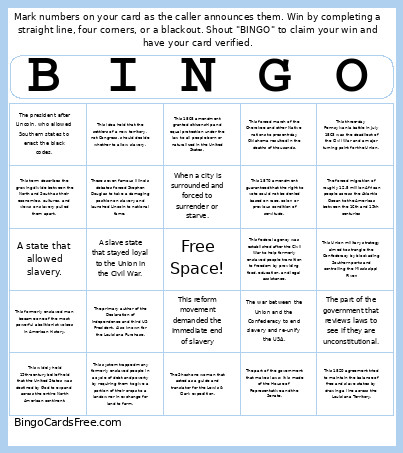 This 7th Grade US History Review Bingo Cards Game contains following Words or Phrases: This president led the Union through the Civil War and issued the Emancipation Proclamation., This formerly enslaved man became one of the most powerful abolitionist voices in American history., This radical abolitionist led a violent raid on Harpers Ferry in 1859 hoping to spark a slave rebellion., The primary author of the Declaration of Independence and third US President. Also known for the Louisiana Purchase., The leader of the Revolutionary Army and first US President., This Union general accepted Robert E. Lee's surrender at Appomattox Court House in 1865., This beloved Southern general commanded the Confederate Army of Northern Virginia throughout the Civil War., The Hero of the Battle of New Orleans and President during the Nullification Crisis. He is credited with creating the Spoils System and signed the Indian Removal Act., This Illinois senator co-authored the Kansas-Nebraska Act and debated Lincoln seven times in 1858., This President started the War of 1812., This Confederate sympathizer assassinated President Lincoln at Ford's Theatre on April 14, 1865., This Radical Republican congressman from Pennsylvania pushed for harsh Reconstruction terms and full Black citizenship., The President that Andrew Jackson hated and accused of earning the position through a corrupt bargain., This president set out to have one term and accomplish four things: lower tariffs, bring back the national bank, gain the Oregon Territory, and acquire California and New Mexico. He did it and stuck to his word, and did not run for president again., The president after Lincoln, who allowed Southern states to enact the black codes., Known as the "Great Compromiser," this senator brokered multiple deals to keep the nation from splitting apart., The president that accepted a Corrupt Bargain to earn the presidency but ended Reconstruction; turning his back on four million African Americans., The Union general known for being too cautious., The explorers hired by President Jefferson to explore the Louisiana Territory., The Shoshone woman that acted as a guide and translator for the Lewis & Clark expedition., The President during the Era of Good Feelings., This three-day Pennsylvania battle in July 1863 was the deadliest of the Civil War and a major turning point for the Union., Confederate forces opened fire on this South Carolina federal fort in April 1861, officially starting the Civil War., This 1862 Maryland battle was the single bloodiest day in American military history., This early Civil War battle shocked Northern spectators who had come to watch and shattered the idea that the war would be short., This period of violent conflict between pro-slavery and anti-slavery settlers previewed the larger Civil War to come., This set of laws that forced all Americans to help return escaped slaves, even in Free States., This 1820 agreement tried to maintain the balance of free and slave states by drawing a line across the Louisiana Territory., The killing of five colonists by British troops in an act of self-defense. This was used as propaganda to paint the British troops as evil and hateful., These seven famous Illinois debates forced Stephen Douglas to take a damaging position on slavery and launched Lincoln to national fame., This 1863 executive order declared enslaved people in Confederate states to be free., Lincoln delivered this brief but legendary speech to dedicate a cemetery and redefine the purpose of the Civil War., The night colonists dressed as Native Americans and threw millions of dollars worth of tea into the Boston Harbor to protest Britain's tea tax., This small Virginia courthouse was the site where Lee surrendered to Grant, effectively ending the Civil War., Just days after the Confederate surrender, the president was shot while attending a play at Ford's Theatre in Washington, D.C., The war between the Union and the Confederacy to end slavery and re-unify the USA., The war to make the 13 colonies independent from Britain., This 1846-1848 conflict resulted in the U.S. gaining roughly half of Mexico's territory, reigniting the debate over the spread of slavery., This conflict with Great Britain is sometimes called America's "second war of independence" and ended with no territory gained or lost by either side., This forced march of the Cherokee and other Native nations to present-day Oklahoma resulted in the deaths of thousands., This post-Civil War era attempted to rebuild the South, reintegrate Confederate states, and define the rights of formerly enslaved people., To formally withdraw, or break away, from a country and make your own country., It marked a period in the political history of the United States that reflected a sense of national purpose and a desire for unity among Americans in the aftermath of the War of 1812., This idea held that the settlers of a new territory, not Congress, should decide whether to allow slavery., This term describes the growing divide between the North and South as their economies, cultures, and views on slavery pulled them apart., This widely held 19th-century belief held that the United States was destined by God to expand across the entire North American continent., This is the act of formally withdrawing from the Union, which eleven Southern states did beginning in 1860-1861., This secret network of safe houses and routes helped thousands of enslaved people escape to freedom in the North or Canada., This political doctrine argued that individual states had the authority to reject federal laws they considered unconstitutional., This 1865 amendment to the Constitution permanently abolished slavery throughout the United States., This 1868 amendment granted citizenship and equal protection under the law to all people born or naturalized in the United States., This 1870 amendment guaranteed that the right to vote could not be denied based on race, color, or previous condition of servitude., This federal agency was established after the Civil War to help formerly enslaved people transition to freedom by providing food, education, and legal assistance., Naval ships block an area from receiving or sending ships., This Union military strategy aimed to strangle the Confederacy by blockading Southern ports and controlling the Mississippi River., This British practice of forcing American sailors into the Royal Navy was one of the key causes of the War of 1812., When a city is surrounded and forced to surrender or starve., A state that outlawed slavery., A state that allowed slavery., A slave state that stayed loyal to the Union in the Civil War., A person killed, injured, or missing after a battle or conflict., The part of the government in charge of enforcing the laws, the president leads this., The part of the government that makes laws; it is made of the House of Representative and the Senate., The part of the government that reviews laws to see if they are unconstitutional., This reform movement demanded the immediate end of slavery, These laws passed by Southern states after the Civil War severely restricted the rights and freedoms of formerly enslaved people., This system trapped many formerly enslaved people in a cycle of debt and poverty by requiring them to give a portion of their crops to a landowner in exchange for land to farm., This military strategy, used famously by Sherman, targeted not just enemy armies but civilian infrastructure and morale., A system in which people are owned as property and forced to work without pay or freedom., The act of setting a person or group free from slavery or oppression., A British rule that only allowed the colonies to trade with Great Britain; this led to a rise in smuggling, and was a key component in causing the revolution., A British rule that banned American colonists from moving west of the Appalachian Mountains., The forced migration of roughly 12.5 million African people across the Atlantic Ocean to the Americas between the 16th and 19th centuries, The massive, post-1492 transfer of plants, animals, diseases, people, technology, and idea.