
Crime Lab Bingo Cards - Print Free or Customize
Print free Crime Lab bingo cards or adjust them, unlimited prints! Select from 42,200+ templates or use the bingo card generator. Add numbers, phrases, images, or mix them all. Play using PDF printouts, online bingo cards, and the online bingo caller, or combine all formats.
About: This bingo card is perfect for anyone curious about the fascinating world of forensic science. Designed with students, career days, or science fair visitors in mind, it encourages engaging conversations and learning about lab work, career paths, technology in forensics, and real-life challenges analysts face. The tone is inquisitive and educational, making it ideal for interactive Q&A sessions.
How To: To save a printable PDF, click the Print button. You can modify the number of cards and other print preferences on the Print tab. Grid items and free space content can be added on the Basic tab. Appearance can be entirely personalized on the relevant tabs, or you can easily find any option using the 🔍 tab.
How to play Crime Lab Bingo Cards?
- Digital Caller: Click on the Play button above.
- Digital Players: Click on the Play button above, and then click on the 🎫 button.
- Paper Players: Print PDF bingo cards and physically write on the cards.
- Paper Caller: Print PDF calling list & calling slips and physically select the slips.
- Combo Play: Choose any combination above. For instance, caller can be either Paper or Digital. And players can be Paper or Digital or a mix of both.
Step-By-Step:
- Start by saving the Crime Lab PDF by clicking on the "Print" button above.
- Open the PDF and print it.
- For random calling, you can print another copy of the call list, cut, fold and then pull them randomly at play time.
- Cut the bingo cards at the cut marks if there are greater than 1 bingo cards per page.
- Distribute one card per player. For marking, you can use markers. Crayons cost the least.
- Choose one person to be the caller. If you are playing in a small group, the caller may as well play along with their own Bingo card.
- The caller initiates the game by randomly drawing an item from the call list and announcing it to all players.
- The players look at their cards to see if they have the called word. If they do, they mark that word.
- The first player to complete a horizontal, vertical, or a diagonal line of marked items yells "Bingo!" and wins the game.
- The caller validates that the items marked form a correct line as per the Bingo card and call list.
- You can play for multiple patterns or a full card blackout for an extended game.
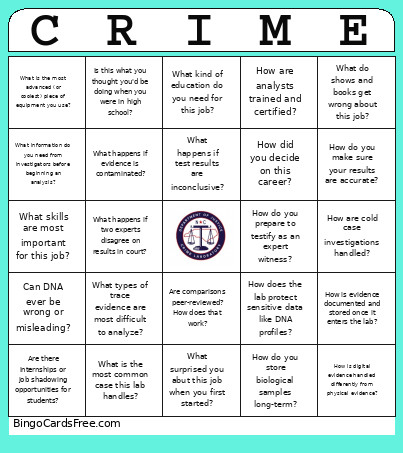 This Crime Lab Bingo Cards Game contains following Words or Phrases: What is the most common case this lab handles?, How is evidence documented and stored once it enters the lab?, How are analysts trained and certified?, What type of cases do you work on the most?, What does a typical day look like?, How long does it usually take to analyze evidence?, What's the most interesting case you've worked on?, How do you handle the stress of important cases?, What happens if evidence is contaminated?, How has technology changed forensic science?, How do you make sure your results are accurate?, Can DNA ever be wrong or misleading?, What kind of education do you need for this job?, Are there internships or job shadowing opportunities for students?, What skills are most important for this job?, How do you make sure your work stays unbiased?, Have you ever had to testify in court? What was that like?, What happens if two experts disagree on results in court?, What is the hardest part of analyzing evidence?, How many points of agreement are required to match fingerprints hers?, What is a common misconception about forensic science?, What mistakes do people make when they are collecting evidence?, What is the most advanced (or coolest) piece of equipment you use?, Are there any new technologies you're excited about?, How did you decide on this career?, Is this what you thought you'd be doing when you were in high school?, What do shows and books get wrong about this job?, What surprised you abut this job when you first started?, Do you ever get to go to crime scenes?, What information do you need from investigators before beginning an analysis?, How is digital evidence handled differently from physical evidence?, How do you store biological samples long-term?, How does the lab protect sensitive data like DNA profiles?, What happens if test results are inconclusive?, How does the lab keep up with new technologies or methods?, How do you prepare to testify as an expert witness?, How often do lab results change the focus of an investigation?, What types of trace evidence are most difficult to analyze?, Are comparisons peer-reviewed? How does that work?, How are cold case investigations handled?.