
Indigeneity, Migration, & Language Bingo Cards - Print Free or Customize
Print free Indigeneity, Migration, & Language bingo cards or alter them, limitless cards! Pick from 41,500+ templates or use the bingo card generator. Add numbers, phrases, photos, or all of them. Play using printed PDF, online bingo cards, and the online bingo caller, or go hybrid.
About: This bingo card explores the powerful connections between language, culture, and identity, especially within immigrant and diasporic communities. With prompts reflecting pride, struggle, and resilience, it’s perfect for cultural workshops or language heritage events aiming to spark meaningful conversations among people reflecting on their own experiences with language and belonging.
How To: To save a PDF to print, click the Print button. You can change the card count and other print options on the Print tab. Grid items and free space text can be added on the Basic tab. Appearance can be exactly personalized on the relevant tabs, or you can easily locate any preference on the 🔍 tab.
How to play Indigeneity, Migration, & Language Bingo Cards?
- Virtual Players: Click on the Play button above, and then click on the 🎫 button.
- Paper Players: Print PDF bingo cards and manually cross off the cards.
- Paper Caller: Print PDF calling list & calling slips and manually draw the slips.
- Virtual Caller: Click on the Play button above.
- Combo Play: Choose any combination above. For example, caller can be either Paper or Virtual. And players can be Paper or Virtual or a combination of both.
Step-By-Step:
- Start by getting the Indigeneity, Migration, & Language Bingo PDF by clicking on the "Print" button above.
- Open the PDF and print it.
- For random calling, you can print another copy of the call list, cut, fold and then pull them randomly at play time.
- Cut the bingo cards at the cut marks if there are greater than 1 bingo cards per page.
- Distribute one card per player. For marking, you can use pens. Crayons cost the least.
- Choose one person to be the caller. If you are playing in a small group, the caller may also play along with their own Bingo card.
- The caller opens the play by randomly picking an item from the call list and saying it to everyone.
- The players scan their cards to see if they have the announced word. If they do, they dab that word.
- The first player to finish a horizontal, vertical, or a diagonal line of marked items announces "Bingo!" and wins the play.
- The caller confirms that the items marked form a correct line as per the Bingo card and call list.
- You can play for multiple patterns or a full card blackout for a longer play.
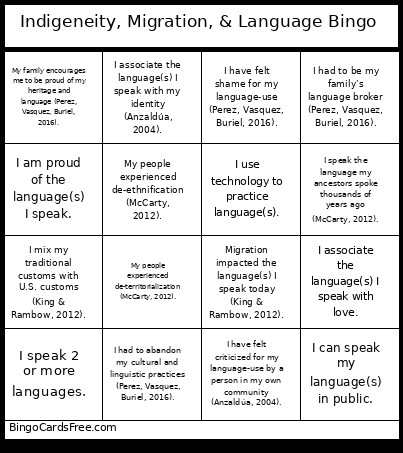 This Indigeneity, Migration, & Language Bingo Cards Game contains following Words or Phrases: I speak the language my ancestors spoke thousands of years ago (McCarty, 2012)., I speak 2 or more languages., I speak a language that was imposed on my ancestors (McCarty, 2012)., I believed that my language/language-use made me dumb or poor (Perez, Vasquez, Buriel, 2016)., I have felt criticized for my language-use by a person in my own community (Anzaldúa, 2004)., I have felt shame for my language-use (Perez, Vasquez, Buriel, 2016)., My people experienced de-territorialization (McCarty, 2012)., My people experienced de-ethnification (McCarty, 2012)., Migration impacted the language(s) I speak today (King & Rambow, 2012)., My ancestors had to abandon their cultural and linguistic practices so I could be here (McCarty, 2012)., I had to abandon my cultural and linguistic practices (Perez, Vasquez, Buriel, 2016)., My parents told me to abandon my cultural and linguistic practices to protect me., I am a diasporic individual (King & Rambow, 2012)., I never returned to my ancestral homelands (King & Rambow, 2012)., I have visited my ancestral homelands and community (King & Rambow, 2012)., I have experienced safe spaces to reclaim my traditional language(s) (King & Rambow, 2012)., I mix my traditional customs with U.S. customs (King & Rambow, 2012)., I use technology to practice language(s)., I associate the language(s) I speak with struggle (Perez, Vasquez, Buriel, 2016)., I associate the language(s) I speak with my spirituality., I associate the language(s) I speak with love., I associate the language(s) I speak with my community., I associate the language(s) I speak with my identity (Anzaldúa, 2004)., I am proud of the language(s) I speak., I can speak my language(s) in public., My family encourages me to be proud of my heritage and language (Perez, Vasquez, Buriel, 2016)., I had to be my family's language broker (Perez, Vasquez, Buriel, 2016)..