
anatomy Bingo Cards - Print Free or Customize
Print free anatomy bingo cards or adjust them, limitless cards! Pick from 41,500+ templates or use our bingo card generator. Add numbers, phrases, images, or mix them all. Play using printed PDF, digital bingo cards, and our digital bingo caller, or combine all formats.
About: This bingo card is perfect for anatomy and physiology students or anyone delving into the world of human biology. Featuring key terms related to body parts, tissues, physiological processes, and anatomical structures, it adds an interactive twist to studying. Great for classroom review, study groups, or as a fun educational activity at science-themed events.
How To: To save a printable PDF, click the Print button. You can adjust the card count and other printing settings on the Print tab. Grid items and free space text can be edited on the Basic tab. Appearance can be totally customized on the corresponding tabs, or you can quickly find any preference on the 🔍 tab.
How to play anatomy Bingo Cards?
- Paper Caller: Print PDF calling list & calling slips and physically choose the slips.
- Paper Players: Print PDF bingo cards and physically write on the cards.
- Digital Caller: Click on the Play button above.
- Digital Players: Click on the Play button above, and then click on the 🎫 button.
- Hybrid Mode: Pick any combination above. For example, caller can be either Offline or Digital. And players can be Offline or Digital or a mix of both.
Step-By-Step:
- Start by downloading the anatomy PDF by clicking on the "Print" button above.
- Open the PDF and print it.
- For random drawing, you can print another copy of the call list, cut, fold and then pull them randomly at play time.
- Cut the bingo cards at the cut lines if there are more than 1 bingo cards per page.
- Distribute one card per player. For marking, you can use pencils. Crayons cost the least.
- Pick one person to be the caller. If you are playing in a small group, the caller may as well play along with their own Bingo card.
- The caller initiates the play by randomly pulling an item from the call list and calling out it to everyone.
- The players look at their cards to see if they have the called word. If they do, they dab that word.
- The first player to finish a horizontal, vertical, or a diagonal line of marked items shouts "Bingo!" and wins the game.
- The caller confirms that the items crossed off form a correct line according to the Bingo card and call list.
- You can play for varied patterns or a full card blackout for a longer game.
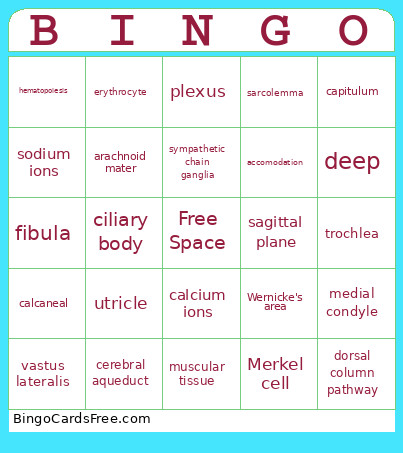 This anatomy Bingo Cards Game contains following Words or Phrases: superior, inferior, anterior, posterior, proximal, distal, medial, lateral, deep, superficial, connective tissue, epithelial tissue, nervous tissue, muscular tissue, sagittal plane, transverse plane, frontal plane, osmosis, cervical, thoracic, acromial, femoral, inguinal, olecranal, lumbar, sacral, brachial, calcaneal, mitochondria, positive feedback loop, negative feedback loop, hematopoiesis, red bone marrow, parathyroid hormone, simple columnar epithelium, simple squamous epithelium, stratified squamous epithelium, erythrocyte, blood, chondrocyte, lacunae, hyaline cartilage, endochondral ossification, humerus, glenoid fossa, scapula, acromion, coracoid process, hinge joint, ball and socket joint, synovial joint, synchondrosis, suture, sarcomere, myofibril, fascicle, sarcolemma, sarcoplasmic reticulum, calcium ions, sodium ions, potassium ions, ethmoid bone, frontal bone, parietal bone, sphenoid bone, temporal bone, occipital bone, styloid process, fibula, radius, deltoid tuberosity, spinous process, transverse foramen, costal facets, axon, dendrite, soma, myelin, oligodendrocyte, ependymal cell, astrocyte, microglia, neuron, sympathetic nervous system, parasympathetic nervous system, somatic nervous system, autonomic nervous system, semicircular canals, tympanic membrane, malleus, incus, staples, cochlea, utricle, gustation, olfaction, thalamus, hypothalamus, frontal lobe, occipital lobe, motor cortex, sclera, retina, cornea, corneal reflex, pupil, photoreceptor, depolarization, hyperpolarization, repolarization, dorsal column pathway, rubrospinal tract, corticobulbar tracts, basal nuclei, Broca's area, Wernicke's area, circle of Willis, cerebral aqueduct, third ventricle, fourth ventricle, confluence of sinuses, pia mater, dura mater, arachnoid mater, sympathetic chain ganglia, plexus, tectospinal tract, decussation, accomodation, rectus femoris, transversus abdominus, vastus lateralis, vastus medialis, latissimus dorsi, biceps brachii, triceps brachii, melanocyte, keratinocyte, Merkel cell, ulna, trochlea, olecranon fossa, capitulum, femur, greater trochanter, lesser trochanter, optic nerve, optic disc, ciliary body, aqueous humor, vitreous humor, adipose tissue, skeletal muscle, cardiac muscle, osteon, osteocyte, osteoclast, osteoblast, protein, lipid, carbohydrate, corpus callosum, cerebellum, arbor vitae, midbrain, pons, medulla oblongata, pituitary gland, optic chiasm, gyrus, sulcus, patellar surface, acetabulum, medial condyle, adductor tubercle.