
Chapter 1 Bingo Cards - Print Free or Customize
Print free Chapter 1 bingo cards or adjust them, unlimited cards! Choose from 42,200+ designs or use the bingo card generator. Add numbers, words, pictures, or all of them. Play using PDF printouts, digital bingo cards, and the digital bingo caller, or combine all formats.
About: This bingo card captures the real-life ups and downs of architecture and design in global health settings, highlighting honest reflections, doubts, and breakthroughs. Perfect for workshops, panel discussions, or classes about collaborative design or humanitarian work, it brings out the candid moments that come when people from different backgrounds team up to make a lasting impact.
How To: To download a printable PDF, click the Print button. You can adjust the card quantity and other print settings on the Print tab. Grid items and free space text can be changed on the Basic tab. Appearance can be totally personalized on the relevant tabs, or you can easily find any setting using the 🔍 tab.
How to play Chapter 1 Bingo Cards?
- Virtual Caller: Click on the Play button above.
- Paper Caller: Print PDF calling list & calling slips and physically draw the slips.
- Paper Players: Print PDF bingo cards and physically mark the cards.
- Virtual Players: Click on the Play button above, and then click on the 🎫 button.
- Mixed Mode: Select any combination above. For instance, caller can be either Paper or Virtual. And players can be Paper or Virtual or a combination of both.
Step-By-Step:
- Start by getting the Chapter 1 PDF by clicking on the "Print" button above.
- Open the PDF and print it.
- For random calling, you can print another copy of the call list, cut, fold and then pick them randomly at play time.
- Cut the bingo cards at the cut marks if there are more than 1 bingo cards per page.
- Distribute one card per player. For marking, you can use pencils. Crayons cost the least.
- Select one person to be the caller. If you are playing in a small group, the caller can also play along with their own Bingo card.
- The caller initiates the game by randomly drawing an item from the call list and saying it to all players.
- The players check their cards to see if they have the called word. If they do, they dab that word.
- The first player to complete a horizontal, vertical, or a diagonal line of crossed items shouts "Bingo!" and wins the play.
- The caller checks that the items crossed off form a correct line as per the Bingo card and call list.
- You can play for multiple patterns or a full card blackout for a longer play.
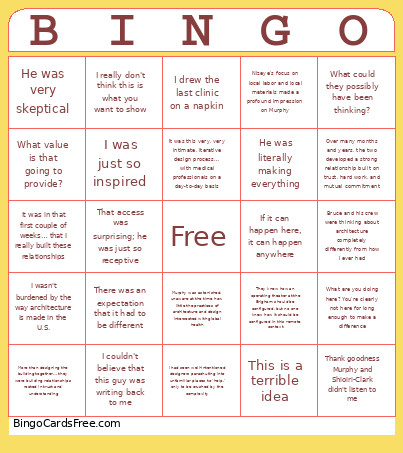 This Chapter 1 Bingo Cards Game contains following Words or Phrases: That access was surprising; he was just so receptive, I drew the last clinic on a napkin, Murphy was astonished, unaware at the time how little the practices of architecture and design intersected with global health, I couldn't believe that this guy was writing back to me, It was meaningless. I was also totally failing on the project, What are you doing here? You're clearly not here for long enough to make a difference, He was very skeptical, It was in that first couple of weeks… that I really built these relationships, I was just so inspired, Bruce and his crew were thinking about architecture completely differently from how I ever had, He was literally making everything, There, if someone needed a chair, Bruce made a chair, Nizeye's focus on local labor and local materials made a profound impression on Murphy, I had seen well-intentioned designers parachuting into unfamiliar places to 'help,' only to be crushed by the complexity, It was not a good design; we just didn't know what we were doing, They needed to be back there, living on-site, working side by side with PIH and the community, It was this very, very intimate, iterative design process… with medical professionals on a day-to-day basis, No one knew how it should be configured in this remote context, There was an expectation that it had to be different, If it can happen here, it can happen anywhere, What value is that going to provide?, It also helped me at least start to hone in on what would be useful for me to do, I wasn't burdened by the way architecture is made in the U.S., This is a terrible idea, What could they possibly have been thinking?, Thank goodness Murphy and Shioiri-Clark didn't listen to me, I really don't think this is what you want to show, It's not the kind of inspiring architecture that we were hoping for, More than designing the building together… they were building relationships rooted in trust and understanding, They knew how an operating theater at the Brigham should be configured, but no one knew how it should be configured in this remote context, Over many months and years, the two developed a strong relationship built on trust, hard work, and mutual commitment.