Print free genomics bingo cards or personalize,
unlimited cards! Choose from 41,500+ templates or use the bingo card generator.
Add numbers, words, pictures, or mix them all.
Play using PDF printouts, digital bingo cards,
and the digital bingo caller, or go hybrid.
About: This bingo card is perfect for a scientific journal club, graduate seminar, or research conference focused on genomics and cancer biology. The questions are designed to challenge participants' knowledge of structural variants, chromatin organization, and data from large-scale cancer studies. It encourages critical thinking and sparks conversations around recent findings in genome architecture and tumor evolution.
How To: To save a printable PDF, click the Print button.
You can modify the number of cards and other
print options on the Print tab.
Grid items and free space content can be edited on the Basic tab.
Appearance can be exactly personalized on the
corresponding tabs, or you can easily search any preference
on the 🔍 tab.
How to play genomics Bingo Cards?
Printed Caller: Print PDF calling list & calling slips and physically draw the slips.
Digital Caller: Click on the Play button above.
Digital Players: Click on the Play button above, and then click on the 🎫 button.
Printed Players: Print PDF bingo cards and physically cross off the cards.
Hybrid Mode: Pick any combination above.
For instance, caller can be either Offline or Digital.
And players can be Offline or Digital or a combination of both.
Step-By-Step:
Start by getting the genomics PDF by clicking on the "Print" button above.
Open the PDF and print a hard copy.
For random drawing, you can print another copy of the call list, cut, fold and then pull them randomly at play time.
Cut the bingo cards at the cut marks if there are more than 1 bingo cards per page.
Distribute one card per player. For marking, you can use pencils. Crayons cost the least.
Pick one person to be the caller. If you are playing in a small group, the caller can also play along with their own Bingo card.
The caller begins the play by randomly drawing an item from the call list and calling out it to everyone.
The players look at their cards to see if they have the called word. If they do, they mark that word.
The first player to complete a horizontal, vertical, or a diagonal line of marked items yells "Bingo!" and wins the play.
The caller verifies that the items crossed off form a proper line according to the Bingo card and call list.
You can play for different patterns or a full card blackout for an extended play.
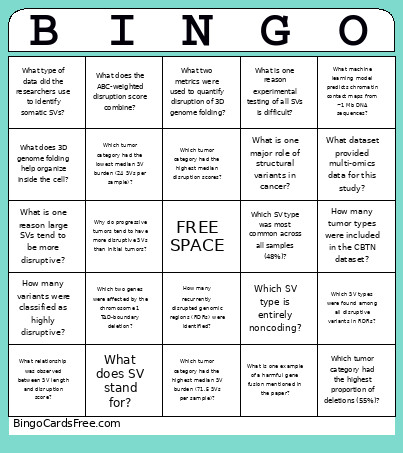
This genomics Bingo Cards Game contains following Words or Phrases: What machine learning model predicts chromatin contact maps from ~1 Mb DNA sequences?, How many tumor types were included in the CBTN dataset?, Which SV type was most common across all samples (48%)?, Which tumor category had the highest median SV burden (71.5 SVs per sample)?, Which tumor category had the lowest median SV burden (24 SVs per sample)?, Which tumor category had the highest median disruption scores?, What two metrics were used to quantify disruption of 3D genome folding?, How many recurrently disrupted genomic regions (RDRs) were identified?, Which SV types were found among all disruptive variants in RDRs?, How many variants were classified as highly disruptive?, Which tumor category had the highest proportion of deletions (55%)?, What relationship was observed between SV length and disruption score?, Which SV type is entirely noncoding?, What does SV stand for?, What does 3D genome folding help organize inside the cell?, What type of data did the researchers use to identify somatic SVs?, What is one example of a harmful gene fusion mentioned in the paper?, What is one reason experimental testing of all SVs is difficult?, What is one reason large SVs tend to be more disruptive?, What is one major role of structural variants in cancer?, What dataset provided multi‑omics data for this study?, Why do progressive tumors tend to have more disruptive SVs than initial tumors?, Which two genes were affected by the chromosome 1 TAD‑boundary deletion?, What does the ABC‑weighted disruption score combine?.

 This genomics Bingo Cards Game contains following Words or Phrases: What machine learning model predicts chromatin contact maps from ~1 Mb DNA sequences?, How many tumor types were included in the CBTN dataset?, Which SV type was most common across all samples (48%)?, Which tumor category had the highest median SV burden (71.5 SVs per sample)?, Which tumor category had the lowest median SV burden (24 SVs per sample)?, Which tumor category had the highest median disruption scores?, What two metrics were used to quantify disruption of 3D genome folding?, How many recurrently disrupted genomic regions (RDRs) were identified?, Which SV types were found among all disruptive variants in RDRs?, How many variants were classified as highly disruptive?, Which tumor category had the highest proportion of deletions (55%)?, What relationship was observed between SV length and disruption score?, Which SV type is entirely noncoding?, What does SV stand for?, What does 3D genome folding help organize inside the cell?, What type of data did the researchers use to identify somatic SVs?, What is one example of a harmful gene fusion mentioned in the paper?, What is one reason experimental testing of all SVs is difficult?, What is one reason large SVs tend to be more disruptive?, What is one major role of structural variants in cancer?, What dataset provided multi‑omics data for this study?, Why do progressive tumors tend to have more disruptive SVs than initial tumors?, Which two genes were affected by the chromosome 1 TAD‑boundary deletion?, What does the ABC‑weighted disruption score combine?.