Print free Middle Ages bingo cards or personalize,
limitless prints! Select from 41,500+ designs or use our bingo card generator.
Add numbers, phrases, images, or any combination.
Play using printed PDF, virtual bingo cards,
and our virtual bingo caller, or mix physical and digital.
About: Step into the fascinating world of the Middle Ages with this bingo card, perfect for history classes, trivia nights, or medieval-themed events. It covers everything from feudalism and religious life to important legal concepts and social roles. Get ready to test your knowledge of a time when knights, nuns, and kings shaped the course of history!
How To: To download a PDF to print, click the Print button.
You can adjust the card count and other
print settings on the Print tab.
Grid items and free space content can be added on the Basic tab.
Appearance can be highly customized on the
relevant tabs, or you can easily find any setting
on the 🔍 tab.
How to play Middle Ages Bingo Cards?
Paper Players: Print PDF bingo cards and physically scratch the cards.
Digital Caller: Click on the Play button above.
Paper Caller: Print PDF calling list & calling slips and physically choose the slips.
Digital Players: Click on the Play button above, and then click on the 🎫 button.
Hybrid Mode: Select any combination above.
For instance, caller can be either Offline or Digital.
And players can be Offline or Digital or a combo of both.
Step-By-Step:
Start by getting the Middle Ages Bingo PDF by clicking on the "Print" button above.
Open the PDF and print it.
For random drawing, you can print another copy of the call list, cut, fold and then draw them randomly at play time.
Cut the bingo cards at the cut marks if there are greater than 1 bingo cards per page.
Distribute one card per player. For marking, you can use pencils. Crayons are the cheapest.
Select one person to be the caller. If you are playing in a small group, the caller can also play along with their own Bingo card.
The caller starts the game by randomly drawing an item from the call list and calling out it to everyone.
The players look at their cards to see if they have the called word. If they do, they dab that word.
The first player to complete a horizontal, vertical, or a diagonal line of crossed items announces "Bingo!" and wins the game.
The caller validates that the items crossed off form a proper line according to the Bingo card and call list.
You can play for different patterns or a full card blackout for a longer game.
This Middle Ages Bingo Cards Game contains following Words or Phrases: Period between ancient times and modern times, roughly from 500 to 1500 CE, Medieval - From the Latin for "Middle Ages", relating to the Middle Ages, Physical features of a place, People who are trained and ordained for religious services, Follower of a polytheistic religion, Someone who tries to convert others to a particular religion, Person believed to be especially holy, Secluded religious community, Religious community for women known as nuns, Sacred rites of Christianity, such as baptism and communion, Large community of Christians spread across the world, In Medieval Europe, a nobleman who received land from other noblemen in return for his service, Estate granted by a lord to a vassal, Code of Conduct in medieval Europe that required knights to be brave, loyal, and honest, A peasant who is legally bound to live and work on land owned by a lord, Practice of changing the use of fields over time, System of planting invented in the High Middle Ages which increased the amount of land that could be planted each year, Association of people who have a common interest, Idea that there are laws in nature that are basic to both the natural world and human affairs, Nonreligious, To exclude a person from a church or a religious community, Journey undertaken to worship at a religious place, A document that promised barons certain rights, A body of law that has developed from custom and from judges' decisions rather than from laws passed by a lawmaking assembly, A court order to bring an arrested person before a judge or court, A court order, An assembly of representatives who make laws, A system of law courts outside the control of other branches of government.

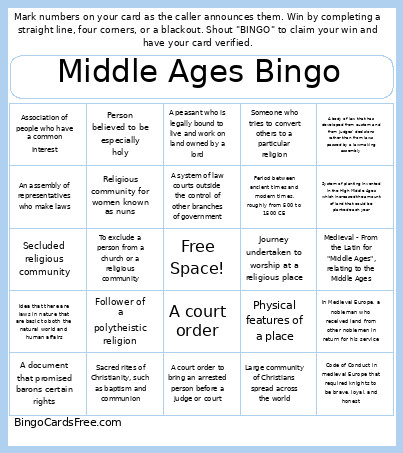 This Middle Ages Bingo Cards Game contains following Words or Phrases: Period between ancient times and modern times, roughly from 500 to 1500 CE, Medieval - From the Latin for "Middle Ages", relating to the Middle Ages, Physical features of a place, People who are trained and ordained for religious services, Follower of a polytheistic religion, Someone who tries to convert others to a particular religion, Person believed to be especially holy, Secluded religious community, Religious community for women known as nuns, Sacred rites of Christianity, such as baptism and communion, Large community of Christians spread across the world, In Medieval Europe, a nobleman who received land from other noblemen in return for his service, Estate granted by a lord to a vassal, Code of Conduct in medieval Europe that required knights to be brave, loyal, and honest, A peasant who is legally bound to live and work on land owned by a lord, Practice of changing the use of fields over time, System of planting invented in the High Middle Ages which increased the amount of land that could be planted each year, Association of people who have a common interest, Idea that there are laws in nature that are basic to both the natural world and human affairs, Nonreligious, To exclude a person from a church or a religious community, Journey undertaken to worship at a religious place, A document that promised barons certain rights, A body of law that has developed from custom and from judges' decisions rather than from laws passed by a lawmaking assembly, A court order to bring an arrested person before a judge or court, A court order, An assembly of representatives who make laws, A system of law courts outside the control of other branches of government.