
U.S.History 8th grade Bingo Cards - Print Free or Customize
Print free U.S.History 8th grade bingo cards or modify, unlimited cards! Pick from 41,500+ templates or use the bingo card generator. Add numbers, phrases, photos, or any combination. Play using printed PDF, virtual bingo cards, and the virtual bingo caller, or combine all formats.
About: This bingo card covers key themes and terms from early American history, making it a perfect fit for classroom activities, study sessions, or review games. It highlights the major events, movements, and ideas that shaped the United States, from colonization and revolution to expansion, reform, and civil rights. Students and history enthusiasts will find it engaging and educational.
How To: To download a PDF to print, click the Print button. You can modify the number of cards and other print options on the Print tab. Grid items and free space text can be added on the Basic tab. Appearance can be fully customized on the corresponding tabs, or you can quickly search any setting using the 🔍 tab.
How to play U.S.History 8th grade Bingo Cards?
- Digital Caller: Click on the Play button above.
- Paper Caller: Print PDF calling list & calling slips and physically select the slips.
- Digital Players: Click on the Play button above, and then click on the 🎫 button.
- Paper Players: Print PDF bingo cards and physically write on the cards.
- Combo Mode: Pick any combination above. For example, caller can be either Offline or Digital. And players can be Offline or Digital or a combo of both.
Step-By-Step:
- Start by getting the U.S.History 8th grade PDF by clicking on the "Print" button above.
- Open the PDF and print it.
- For random calling, you can print another copy of the call list, cut, fold and then pick them randomly at play time.
- Cut the bingo cards at the cut lines if there are greater than 1 bingo cards per page.
- Give one card to each player. For marking, you can use pencils. Crayons are the cheapest.
- Pick one person to be the caller. If you are playing in a small group, the caller may also play along with their own Bingo card.
- The caller begins the play by randomly drawing an item from the call list and announcing it to everyone.
- The players look at their cards to see if they have the announced word. If they do, they dab that word.
- The first player to complete a horizontal, vertical, or a diagonal line of marked items announces "Bingo!" and wins the play.
- The caller checks that the items marked form a correct line according to the Bingo card and call list.
- You can play for varied patterns or a full card blackout for a longer play.
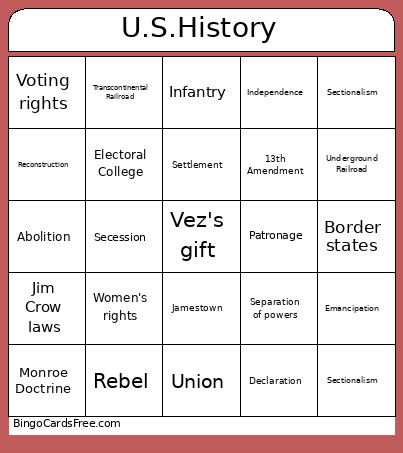 This U.S.History 8th grade Bingo Cards Game contains following Words or Phrases: Columbian Exchange, Mercantilism, Navigation, Conquistador, Circumnavigation, Colony, New World, God, Glory, Gold, Colony, Charter, Jamestown, Cash crop, Tobacco, Indentured servant, Slavery, Middle Passage, Triangular Trade, Mercantilism, Self-government, House of Burgesses, Mayflower Compact, Pilgrims, Puritans, Religious freedom, Subsistence farming, Taxation without representation, Parliament, Boycott, Protest, Repeal, Militia, Patriot, Loyalist, Neutral, Declaration, Independence, Tyranny, Propaganda, Stamp Act, Intolerable Acts, Revolution, Liberty, Grievance, Representation, Sugar Act, Constitution, Articles of Confederation, Federalism, Separation of powers, Checks and balances, Legislative branch, Executive branch, Judicial branch, Amendment, Bill of Rights, Ratify, Compromise, Great Compromise, Three-Fifths Compromise, Federalist, Anti-Federalist, Republic, Popular sovereignty, Limited government, Electoral College, Judicial review, Marbury v. Madison, Louisiana Purchase, Expedition, Embargo, Impressment, Neutrality, XYZ Affair, Nationalism, Sectionalism, Tariff, Infrastructure, Monroe Doctrine, Era of Good Feelings, Suffrage, Cabinet, Precedent, Foreign policy, Domestic policy, Territory, Jacksonian Democracy, Spoils system, Veto, Nullification, Indian Removal Act, Trail of Tears, Bank of the United States, Tariff of Abominations, States' rights, Popular vote, Executive power, Political party, Democrats, Whigs, Expansion of suffrage, Sectionalism, Frontier, Democracy, Patronage, Abolition, Temperance, Suffrage, Women's rights, Seneca Falls Convention, Reform movement, Education reform, Horace Mann, Dorothea Dix, Frederick Douglass, Harriet Tubman, Underground Railroad, Henry David Thoreau, Prison reform, Labor reform, Social justice, Moral reform, Anti-slavery movement, Manifest Destiny, Frontier, Louisiana Purchase, Lewis and Clark Expedition, Oregon Trail, Gold Rush, Homestead Act, Annexation of Texas, Mexican-American War, Treaty of Guadalupe Hidalgo, Gadsden Purchase, Transcontinental Railroad, Expansionism, Territory, Settlement, Immigration, Mining, Sectionalism (1820s–1860s), Sectionalism, North vs South, Slavery, Abolition, Nullification, States' rights, Tariffs, Cotton Gin, Plantation economy, Free states, Slave states, Missouri Compromise, Compromise of 1850, Fugitive Slave Act, Kansas-Nebraska Act, Popular sovereignty, Underground Railroad, Border states, Secession, Confederacy, Secession, Union, Emancipation, Emancipation Proclamation, Gettysburg Address, Reconstruction, Total war, Blockade, Ironclad, Border states, Underground Railroad, States' rights, Abolition, Civil liberties, Cavalry, Infantry, Siege, Rebel, Reconstruction, Freedmen, Freedmen's Bureau, Black Codes, 13th Amendment, 14th Amendment, 15th Amendment, Sharecropping, Carpetbagger, Scalawag, Jim Crow laws, Segregation, Ku Klux Klan, Impeachment, Civil Rights, Reconstruction Acts, Radical Republicans, Southern economy, Voting rights, Integration.