
Year 9 Democracy Bingo Cards - Print Free or Customize
Print free Year 9 Democracy bingo cards or customize, unlimited prints! Choose from 42,200+ templates or use the bingo card generator. Add numbers, words, pictures, or mix them all. Play using PDF printouts, online bingo cards, and the online bingo caller, or mix physical and digital.
About: This bingo card is all about Australian democracy and the key concepts that shape politics, elections, and civic life down under. It's perfect for classrooms, community workshops, or anyone wanting to boost their understanding of how Australia's government works, the values it’s built on, and the ways citizens can get involved and make a difference.
How To: To save a PDF to print, click the Print button. You can modify the number of cards and other printing settings on the Print tab. Grid items and free space content can be edited on the Basic tab. Appearance can be fully customized on the corresponding tabs, or you can easily search any preference on the 🔍 tab.
How to play Year 9 Democracy Bingo Cards?
- Online Caller: Click on the Play button above.
- Printed Caller: Print PDF calling list & calling slips and manually select the slips.
- Online Players: Click on the Play button above, and then click on the 🎫 button.
- Printed Players: Print PDF bingo cards and manually scratch the cards.
- Hybrid Mode: Choose any combination above. For instance, caller can be either Printed or Online. And players can be Printed or Online or a mix of both.
Step-By-Step:
- Start by saving the Year 9 Democracy PDF by clicking on the "Print" button above.
- Open the PDF and print it.
- For random drawing, you can print another copy of the call list, cut, fold and then draw them randomly at play time.
- Cut the bingo cards at the cut lines if there are greater than 1 bingo cards per page.
- Give one card to each player. For marking, you can use pens. Crayons cost the least.
- Choose one person to be the caller. If you are playing in a small group, the caller can also play along with their own Bingo card.
- The caller initiates the play by randomly picking an item from the call list and announcing it to everyone.
- The players check their cards to see if they have the called word. If they do, they cross off that word.
- The first player to finish a horizontal, vertical, or a diagonal line of marked items announces "Bingo!" and wins the game.
- The caller confirms that the items crossed off form a correct line as per the Bingo card and call list.
- You can play for different patterns or a full card blackout for an extended game.
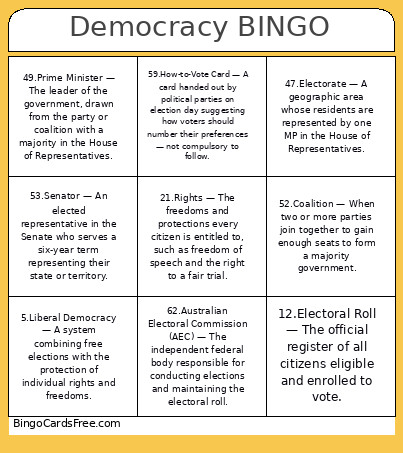 This Year 9 Democracy Bingo Cards Game contains following Words or Phrases: 1.Democracy — A system of government where citizens choose their leaders through free and fair elections., 2.Representative Democracy — Citizens elect representatives to make decisions on their behalf in parliament., 3.Constitution — The document that sets out the rules for how Australia is governed and protects certain rights., 4.Rule of Law — Everyone, including the government, must follow the law equally — no one is above it., 5.Liberal Democracy — A system combining free elections with the protection of individual rights and freedoms., 6.Westminster System — Australia's model of parliamentary government, inherited from Britain., 7.Political Party — A group of people with shared beliefs who work together to win elections and govern., 8.Preferential Voting — A voting system where voters rank all candidates in order of preference (1, 2, 3...)., 9.Proportional Representation — A voting system where a party's share of seats reflects their share of votes received., 10.Compulsory Voting — A legal requirement for all eligible Australian citizens to enrol and vote in elections., 11.Secret Ballot — Votes are marked in private so no one can pressure or identify how a person voted., 12.Electoral Roll — The official register of all citizens eligible and enrolled to vote., 13.Balance of Power — When minor parties or independents hold enough seats to influence which party can govern., 14.Bias — When information is presented in a way that favours one side or viewpoint over another., 15.Confirmation Bias — The tendency to seek out and believe only information that confirms what you already think., 16.Disinformation — False or misleading information spread deliberately to deceive the public., 17.Interest Group — An organisation that supports a political party or policy because it aligns with their goals., 18.Accountability — The requirement for those in power to answer for and justify their decisions and actions., 19.Civic Participation — Taking an active role in democracy beyond voting, such as protesting, volunteering, or staying informed., 20.Disclosure Threshold — The minimum donation amount that must be publicly reported to the Australian Electoral Commission., 21.Rights — The freedoms and protections every citizen is entitled to, such as freedom of speech and the right to a fair trial., 22.Responsibilities — The duties citizens are expected to carry out, such as obeying the law and voting., 23.Justice — The fair and equal treatment of all people under the law., 24.Democratic Values — The principles that underpin a democracy, such as fairness, equality, freedom, and respect for the law., 25.Bill of Rights — A formal written document listing the rights and freedoms guaranteed to citizens. Australia does not currently have one., 26.Intentional Bias — When a creator deliberately presents information in a one-sided way to influence the audience., 27.Unintentional Bias — When a creator presents one-sided information without realising it, often due to their own background or beliefs., 28.Source Analysis — Critically examining where information comes from and whether it can be trusted., 29.Perspective — A particular point of view shaped by a person's experiences, background, and values., 30.Authoritarian — A system where a leader or group holds strong, often unchecked power and limits citizens' freedoms., 31.Totalitarian — An extreme form of authoritarian rule where the government controls nearly every aspect of citizens' lives., 32.Dictatorship — A system where one person holds absolute power, usually gained by force rather than election., 33.Oligarchy — A system where a small group of powerful people, often wealthy or military, hold control., 34.Theocracy — A system where religious leaders govern and laws are based on religious texts., 35.Anarchy — The absence of any formal government or authority, often leading to instability., 36.Monarchy — A system ruled by a king or queen — can be absolute (full power) or constitutional (limited by law)., 37.Republic — A system where power belongs to the citizens, who elect representatives — there is no monarch., 38.Communism — A system where the state controls the economy and resources are theoretically shared equally among citizens., 39.Multi-party System — A political system where multiple parties compete for power, giving voters a genuine choice., 40.Human Rights — The basic rights and freedoms every person is entitled to simply by being human., 41.Equity — Fairness — ensuring all people have equal value and opportunity regardless of their background., 42.Tolerance — Accepting and respecting people whose opinions, beliefs, or backgrounds differ from your own., 43.Freedom — The right of citizens to act, speak, and think without government interference, within the law., 44.Independent — An MP who does not belong to any political party and votes based on personal judgement., 45.House of Representatives — The lower house of Australia's Parliament, with 150 members elected to represent local electorates., 46.Senate — The upper house of Australia's Parliament, where senators represent states and territories., 47.Electorate — A geographic area whose residents are represented by one MP in the House of Representatives., 48.Majority — Winning more than half the available seats — 76 out of 150 — needed to form government., 49.Prime Minister — The leader of the government, drawn from the party or coalition with a majority in the House of Representatives., 50.Minister — An MP appointed to oversee a specific area of government policy, such as health or education., 51.Cabinet — The group of senior ministers who meet to make the most important government decisions and set policy direction., 52.Coalition — When two or more parties join together to gain enough seats to form a majority government., 53.Senator — An elected representative in the Senate who serves a six-year term representing their state or territory., 54.Universal Adult Suffrage — The right of all adult citizens to vote in elections, regardless of gender, race, or background., 55.First Preference — The candidate a voter ranks as number one on their ballot paper., 56.Preference Distribution — The process of redistributing votes from eliminated candidates to the next preferred candidate until a winner is decided., 57.Exit Poll — A survey conducted outside a polling booth asking people who they voted for, used to make early predictions about results., 58.Polling Booth — The physical location where citizens go to cast their vote on election day., 59.How-to-Vote Card — A card handed out by political parties on election day suggesting how voters should number their preferences — not compulsory to follow., 60.Political Campaign — An organised effort by a party or candidate to win votes through advertising, events, and community outreach., 61.Political Donation — Money or resources given to a political party by individuals or organisations, subject to legal disclosure rules., 62.Australian Electoral Commission (AEC) — The independent federal body responsible for conducting elections and maintaining the electoral roll., 63.Letterboxing — A campaign strategy where volunteers deliver political leaflets to homes across an electorate., 64.Doorknocking — A campaign strategy where candidates or volunteers visit voters at home to speak directly and seek their support., 65.Polling — Conducting surveys of voters to track opinions on campaigns, policies, and leaders, often daily during elections., 66.Social Cohesion — The ability of a society to function together based on shared values, trust, and mutual respect., 67.Propaganda — Information, often biased or misleading, used to promote a particular political cause or point of view., 68.Generation Z — People born between 1997 and 2012, a demographic group that predominantly uses social media as their main news source., 69.March 4 Justice — A 2021 movement where thousands of Australians rallied to demand stronger action on gender-based violence, influencing political debate., 70.Social Media — Online platforms su.