Print free 8th Grade SC Ready Review bingo cards or modify,
limitless cards! Pick from 41,500+ templates or use the bingo card generator.
Add numbers, words, pictures, or any combination.
Play using PDF prints, digital bingo cards,
and the digital bingo caller, or mix physical and digital.
About: This bingo card is perfect for middle school or early high school math classes, especially when reviewing key concepts in statistics, algebra, and geometry. It’s a fun way to reinforce learning about functions, number types, graph interpretation, probability, and more. Teachers can use it during test prep or as an engaging classroom activity to keep students motivated.
How To: To save a PDF to print, click the Print button.
You can adjust the number of cards and other
printing settings on the Print tab.
Grid items and free space text can be edited on the Basic tab.
Appearance can be highly personalized on the
relevant tabs, or you can easily search any setting
on the 🔍 tab.
How to play 8th Grade SC Ready Review Bingo Cards?
Virtual Players: Click on the Play button above, and then click on the 🎫 button.
Virtual Caller: Click on the Play button above.
Printed Caller: Print PDF calling list & calling slips and physically choose the slips.
Printed Players: Print PDF bingo cards and physically mark the cards.
Mixed Play: Select any combination above.
For instance, caller can be either Printed or Virtual.
And players can be Printed or Virtual or a combination of both.
Step-By-Step:
Start by downloading the 8th Grade SC Ready Review PDF by clicking on the "Print" button above.
Open the PDF and print it.
For random calling, you can print another copy of the call list, cut, fold and then draw them randomly at play time.
Cut the bingo cards at the cut lines if there are more than 1 bingo cards per page.
Distribute one card per player. For marking, you can use pens. Crayons cost the least.
Select one person to be the caller. If you are playing in a small group, the caller may also play along with their own Bingo card.
The caller opens the play by randomly pulling an item from the call list and calling out it to everyone.
The players check their cards to see if they have the announced word. If they do, they dab that word.
The first player to complete a horizontal, vertical, or a diagonal line of marked items shouts "Bingo!" and wins the play.
The caller verifies that the items crossed off form a proper line as per the Bingo card and call list.
You can play for multiple patterns or a full card blackout for an extended play.
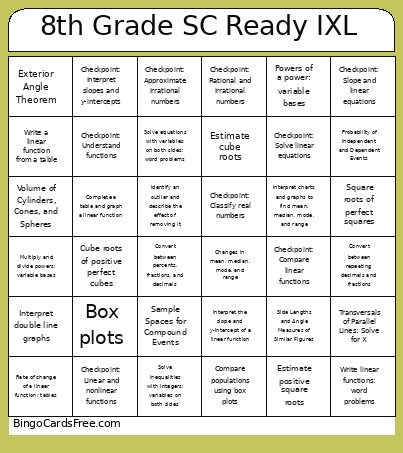
This 8th Grade SC Ready Review Bingo Cards Game contains following Words or Phrases: Interpret charts and graphs to find mean, median, mode, and range, Identify an outlier and describe the effect of removing it, Changes in mean, median, mode, and range, Box plots, Compare populations using box plots, Interpret double line graphs, Convert between repeating decimals and fractions, Convert between percents, fractions, and decimals, Checkpoint: Rational and irrational numbers, Checkpoint: Approximate irrational numbers, Checkpoint: Classify real numbers, Checkpoint: Understand functions, Complete a table and graph a linear function, Rate of change of a linear function: tables, Interpret the slope and y-intercept of a linear function, Write a linear function from a table, Write linear functions: word problems, Checkpoint: Compare linear functions, Checkpoint: Linear and nonlinear functions, Solve equations with variables on both sides: word problems, Checkpoint: Solve linear equations, Solve inequalities with integers: variables on both sides, Checkpoint: Interpret slopes and y-intercepts, Checkpoint: Slope and linear equations, Square roots of perfect squares, Estimate positive square roots, Cube roots of positive perfect cubes, Estimate cube roots, Multiply and divide powers: variable bases, Powers of a power: variable bases, Side Lengths and Angle Measures of Similar Figures, Exterior Angle Theorem, Transversals of Parallel Lines: Solve for X, Volume of Cylinders, Cones, and Spheres, Probability of Independent and Dependent Events, Sample Spaces for Compound Events.

 This 8th Grade SC Ready Review Bingo Cards Game contains following Words or Phrases: Interpret charts and graphs to find mean, median, mode, and range, Identify an outlier and describe the effect of removing it, Changes in mean, median, mode, and range, Box plots, Compare populations using box plots, Interpret double line graphs, Convert between repeating decimals and fractions, Convert between percents, fractions, and decimals, Checkpoint: Rational and irrational numbers, Checkpoint: Approximate irrational numbers, Checkpoint: Classify real numbers, Checkpoint: Understand functions, Complete a table and graph a linear function, Rate of change of a linear function: tables, Interpret the slope and y-intercept of a linear function, Write a linear function from a table, Write linear functions: word problems, Checkpoint: Compare linear functions, Checkpoint: Linear and nonlinear functions, Solve equations with variables on both sides: word problems, Checkpoint: Solve linear equations, Solve inequalities with integers: variables on both sides, Checkpoint: Interpret slopes and y-intercepts, Checkpoint: Slope and linear equations, Square roots of perfect squares, Estimate positive square roots, Cube roots of positive perfect cubes, Estimate cube roots, Multiply and divide powers: variable bases, Powers of a power: variable bases, Side Lengths and Angle Measures of Similar Figures, Exterior Angle Theorem, Transversals of Parallel Lines: Solve for X, Volume of Cylinders, Cones, and Spheres, Probability of Independent and Dependent Events, Sample Spaces for Compound Events.