
BIAS BINGO Cards - Print Free or Customize
Print free BIAS BINGO cards or modify, unlimited prints! Select from 41,500+ designs or use our bingo card generator. Add numbers, phrases, photos, or all of them. Play using PDF prints, digital bingo cards, and our digital bingo caller, or mix physical and digital.
About: This bingo card tackles workplace biases and stereotypes that can show up in retail or customer service environments. It's a great tool for diversity, equity, and inclusion workshops or team meetings, helping groups reflect on subtle judgments that affect coworkers and customers alike. Expect some eye-opening moments as people recognize how these assumptions pop up every day.
How To: To download a PDF to print, click the Print button. You can change the card count and other print preferences on the Print tab. Grid items and free space text can be edited on the Basic tab. Appearance can be entirely customized on the relevant tabs, or you can easily search any setting using the 🔍 tab.
How to play BIAS BINGO Cards?
- Paper Players: Print PDF bingo cards and manually mark the cards.
- Virtual Caller: Click on the Play button above.
- Virtual Players: Click on the Play button above, and then click on the 🎫 button.
- Paper Caller: Print PDF calling list & calling slips and manually draw the slips.
- Hybrid Mode: Select any combination above. For instance, caller can be either Offline or Virtual. And players can be Offline or Virtual or a combo of both.
Step-By-Step:
- Start by getting the BIAS BINGO PDF by clicking on the "Print" button above.
- Open the PDF and print it.
- For random calling, you can print another copy of the call list, cut, fold and then draw them randomly at play time.
- Cut the bingo cards at the cut marks if there are more than 1 bingo cards per page.
- Give one card to each player. For marking, you can use pens. Crayons are the cheapest.
- Select one person to be the caller. If you are playing in a small group, the caller can also play along with their own Bingo card.
- The caller begins the game by randomly picking an item from the call list and saying it to all players.
- The players check their cards to see if they have the announced word. If they do, they dab that word.
- The first player to finish a horizontal, vertical, or a diagonal line of marked items yells "Bingo!" and wins the play.
- The caller validates that the items marked form a proper line according to the Bingo card and call list.
- You can play for multiple patterns or a full card blackout for a longer play.
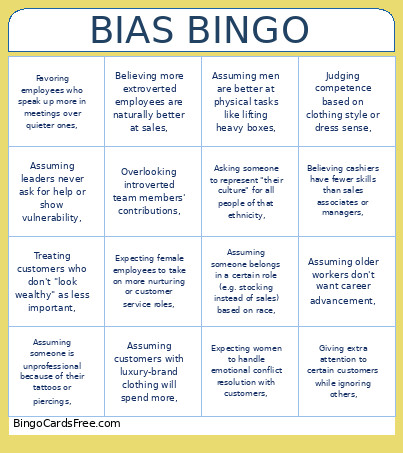 This BIAS BINGO Cards Game contains following Words or Phrases: Assuming someone is unprofessional because of their tattoos or piercings,, Judging competence based on clothing style or dress sense,, Assuming someone is more trustworthy because they "look clean-cut",, Believing someone is less capable because of their weight or body size,, Assuming younger employees lack maturity or responsibility,, Assuming older employees resist change or can't adapt to new technology,, Thinking younger workers should always close shifts or weekends,, Assuming older workers don't want career advancement,, Expecting female employees to take on more nurturing or customer service roles,, Assuming men are better at physical tasks like lifting heavy boxes,, Expecting women to handle emotional conflict resolution with customers,, Assuming men are natural leaders in management roles,, Assuming language proficiency based on someone's accent or appearance,, Asking someone to represent "their culture" for all people of that ethnicity,, Believing a person of color is hired only because of diversity goals,, Assuming someone belongs in a certain role (e.g. stocking instead of sales) based on race,, Assuming part-time workers are less dedicated than full-time staff,, Believing cashiers have fewer skills than sales associates or managers,, Overlooking employees in quiet roles (e.g. stock room) for promotions,, Assuming leaders never ask for help or show vulnerability,, Assuming customers with luxury-brand clothing will spend more,, Treating customers who don't "look wealthy" as less important,, Assuming teenagers are more likely to steal,, Giving extra attention to certain customers while ignoring others,, Favoring employees who speak up more in meetings over quieter ones,, Overlooking introverted team members' contributions,, Assuming experienced workers don't need training or coaching,, Believing more extroverted employees are naturally better at sales,, Assuming someone with a disability can't perform key tasks,, Believing employees with health conditions will be a "burden" on scheduling,, Not accommodating different learning styles in training,, Underestimating employees who process information differently.