Print free Giftedness bingo cards or customize,
unlimited cards! Choose from 43,200+ templates or use our bingo card generator.
Add numbers, phrases, images, or any combination.
Play using PDF prints, digital bingo cards,
and our digital bingo caller, or mix physical and digital.
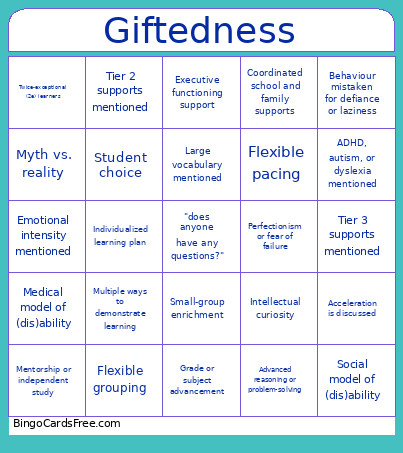
About: This bingo card dives into the complexities of gifted education, spotlighting common misconceptions and real challenges faced by gifted and twice-exceptional students. Perfect for teacher workshops, parent groups, or school staff meetings, it encourages thoughtful conversations about support strategies, diverse learning needs, and the wide range of experiences found among gifted learners.
How To: To save a PDF to print, click the Print button.
You can adjust the card count and other
print options on the Print tab.
Grid items and free space content can be changed on the Basic tab.
Appearance can be entirely personalized on the
corresponding tabs, or you can easily locate any preference
using the 🔍 tab.
How to play Giftedness Bingo Cards?
Digital Caller: Click on the Play button above.
Digital Players: Click on the Play button above, and then click on the 🎫 button.
Paper Players: Print PDF bingo cards and physically scratch the cards.
Paper Caller: Print PDF calling list & calling slips and physically select the slips.
Hybrid Mode: Select any combination above.
For instance, caller can be either Paper or Digital.
And players can be Paper or Digital or a combination of both.
Step-By-Step:
Start by saving the Giftedness PDF by clicking on the "Print" button above.
Open the PDF and print a hard copy.
For random calling, you can print another copy of the call list, cut, fold and then pull them randomly at play time.
Cut the bingo cards at the cut lines if there are greater than 1 bingo cards per page.
Distribute one card per player. For marking, you can use pencils. Crayons cost the least.
Select one person to be the caller. If you are playing in a small group, the caller can as well play along with their own Bingo card.
The caller initiates the play by randomly drawing an item from the call list and calling out it to everyone.
The players check their cards to see if they have the called word. If they do, they dab that word.
The first player to complete a horizontal, vertical, or a diagonal line of marked items shouts "Bingo!" and wins the play.
The caller verifies that the items crossed off form a proper line according to the Bingo card and call list.
You can play for varied patterns or a full card blackout for a longer play.
This Giftedness Bingo Cards Game contains following Words or Phrases: Giftedness is more than academic achievement, Advanced reasoning or problem-solving, Intellectual curiosity, Creativity or original thinking, Large vocabulary mentioned, Giftedness is uneven across subjects, Gifted students can get average or poor grades, Myth vs. reality, Gifted students can experience boredom or disengagement, Twice-exceptional (2e) learners, ADHD, autism, or dyslexia mentioned, Asynchronous development, Emotional intensity mentioned, Perfectionism or fear of failure, Acceleration is discussed, Medical model of (dis)ability, Social model of (dis)ability, Economic model of giftedness, Environmental barriers to learning, Difficulty finding like-minded peers, Giftedness being overlooked or misidentified, Behaviour mistaken for defiance or laziness, Tier 1 supports mentioned, Universal Design for Learning (UDL), Pre-assessment, Flexible grouping, Enrichment, Student choice, Flexible pacing, Tier 2 supports mentioned, Small-group enrichment, Subject-specific acceleration, Mentorship or independent study, Executive functioning support, Social-emotional support, Tier 3 supports mentioned, Individualized learning plan, Grade or subject advancement, One-to-one mentorship, Coordinated school and family supports, Independent projects instead of extra work, Flexible curriculum, Collaboration or team teaching, Multiple ways to demonstrate learning.

 This Giftedness Bingo Cards Game contains following Words or Phrases: Giftedness is more than academic achievement, Advanced reasoning or problem-solving, Intellectual curiosity, Creativity or original thinking, Large vocabulary mentioned, Giftedness is uneven across subjects, Gifted students can get average or poor grades, Myth vs. reality, Gifted students can experience boredom or disengagement, Twice-exceptional (2e) learners, ADHD, autism, or dyslexia mentioned, Asynchronous development, Emotional intensity mentioned, Perfectionism or fear of failure, Acceleration is discussed, Medical model of (dis)ability, Social model of (dis)ability, Economic model of giftedness, Environmental barriers to learning, Difficulty finding like-minded peers, Giftedness being overlooked or misidentified, Behaviour mistaken for defiance or laziness, Tier 1 supports mentioned, Universal Design for Learning (UDL), Pre-assessment, Flexible grouping, Enrichment, Student choice, Flexible pacing, Tier 2 supports mentioned, Small-group enrichment, Subject-specific acceleration, Mentorship or independent study, Executive functioning support, Social-emotional support, Tier 3 supports mentioned, Individualized learning plan, Grade or subject advancement, One-to-one mentorship, Coordinated school and family supports, Independent projects instead of extra work, Flexible curriculum, Collaboration or team teaching, Multiple ways to demonstrate learning.