
School Board Meeting Bingo Cards - Print Free or Customize
Print free School Board Meeting bingo cards or alter them, limitless prints! Choose from 41,500+ templates or use our bingo card generator. Add numbers, phrases, photos, or all of them. Play using PDF prints, online bingo cards, and our online bingo caller, or mix physical and digital.
About: This bingo card is designed for school board meetings or educational forums, capturing key topics and moments that frequently come up in these settings. With a focus on real discussions about policy, equity, student well-being, and community voices, it's perfect for engaging staff, families or anyone involved in K-12 education. Get ready to mark a square every time a classic boardroom topic pops up!
How To: To get a PDF to print, click the Print button. You can alter the card quantity and other printing settings on the Print tab. Grid items and free space content can be changed on the Basic tab. Appearance can be highly customized on the corresponding tabs, or you can easily find any preference on the 🔍 tab.
How to play School Board Meeting Bingo Cards?
- Virtual Caller: Click on the Play button above.
- Printed Caller: Print PDF calling list & calling slips and physically draw the slips.
- Printed Players: Print PDF bingo cards and physically cross off the cards.
- Virtual Players: Click on the Play button above, and then click on the 🎫 button.
- Combo Mode: Pick any combination above. For example, caller can be either Offline or Virtual. And players can be Offline or Virtual or a combination of both.
Step-By-Step:
- Start by saving the School Board Meeting PDF by clicking on the "Print" button above.
- Open the PDF and print it.
- For random drawing, you can print another copy of the call list, cut, fold and then draw them randomly at play time.
- Cut the bingo cards at the cut lines if there are greater than 1 bingo cards per page.
- Distribute one card per player. For marking, you can use pens. Crayons cost the least.
- Pick one person to be the caller. If you are playing in a small group, the caller can also play along with their own Bingo card.
- The caller starts the play by randomly drawing an item from the call list and saying it to all players.
- The players look at their cards to see if they have the announced word. If they do, they dab that word.
- The first player to complete a horizontal, vertical, or a diagonal line of marked items yells "Bingo!" and wins the play.
- The caller confirms that the items crossed off form a correct line as per the Bingo card and call list.
- You can play for multiple patterns or a full card blackout for an extended play.
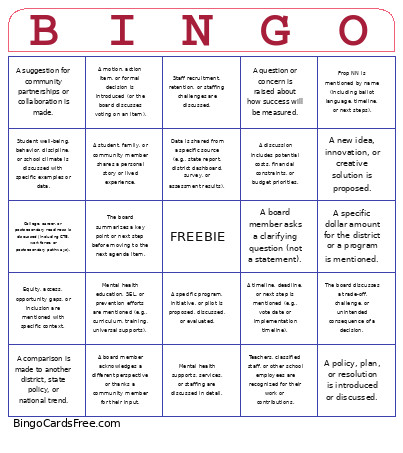 This School Board Meeting Bingo Cards Game contains following Words or Phrases: Prop NN is mentioned by name (including ballot language, timeline, or next steps)., A specific dollar amount for the district or a program is mentioned., A board member asks a clarifying question (not a statement)., Mental health supports, services, or staffing are discussed in detail., A student, family, or community member shares a personal story or lived experience., Data is shared from a specific source (e.g., state report, district dashboard, survey, or assessment results)., Staff recruitment, retention, or staffing challenges are discussed., A specific program, initiative, or pilot is proposed, discussed, or evaluated., The board discusses a trade-off, challenge, or unintended consequence of a decision., Equity, access, opportunity gaps, or inclusion are mentioned with specific context., A policy, plan, or resolution is introduced or discussed., A comparison is made to another district, state policy, or national trend., A timeline, deadline, or next step is mentioned (e.g., vote date or implementation timeline)., A board member acknowledges a different perspective or thanks a community member for their input., Student well-being, behavior, discipline, or school climate is discussed with specific examples or data., A suggestion for community partnerships or collaboration is made., Teachers, classified staff, or other school employees are recognized for their work or contributions., A question or concern is raised about how success will be measured., College, career, or postsecondary readiness is discussed (including CTE, workforce, or postsecondary pathways)., A discussion includes potential costs, financial constraints, or budget priorities., A new idea, innovation, or creative solution is proposed., The board summarizes a key point or next step before moving to the next agenda item., Mental health education, SEL, or prevention efforts are mentioned (e.g., curriculum, training, universal supports)., A motion, action item, or formal decision is introduced (or the board discusses voting on an item)..