Storytime Favorites Bingo Cards - Print Free or Customize
Print free Storytime Favorites bingo cards or adjust them,
limitless cards! Choose from 42,200+ designs or use the bingo card generator.
Add numbers, words, images, or mix them all.
Play using printed PDF, online bingo cards,
and the online bingo caller, or combine all formats.
About: This bingo card focuses on building early childhood development skills in a fun, interactive way. Perfect for preschool classrooms or family engagement events, it encourages children and caregivers to explore early literacy, counting, music, and fine motor activities together. The tone is supportive and playful, aiming to foster learning through hands-on experiences and strong relationships.
How To: To save a printable PDF, click the Print button.
You can alter the card quantity and other
printing preferences on the Print tab.
Grid items and free space content can be added on the Basic tab.
Appearance can be highly personalized on the
relevant tabs, or you can easily search any option
using the 🔍 tab.
How to play Storytime Favorites Bingo Cards?
Printed Caller: Print PDF calling list & calling slips and physically select the slips.
Online Caller: Click on the Play button above.
Printed Players: Print PDF bingo cards and physically cross off the cards.
Online Players: Click on the Play button above, and then click on the 🎫 button.
Mixed Play: Select any combination above.
For instance, caller can be either Paper or Online.
And players can be Paper or Online or a combo of both.
Step-By-Step:
Start by getting the Storytime Favorites PDF by clicking on the "Print" button above.
Open the PDF and print it.
For random calling, you can print another copy of the call list, cut, fold and then pull them randomly at play time.
Cut the bingo cards at the cut lines if there are more than 1 bingo cards per page.
Distribute one card per player. For marking, you can use pens. Crayons are the cheapest.
Select one person to be the caller. If you are playing in a small group, the caller can as well play along with their own Bingo card.
The caller opens the play by randomly drawing an item from the call list and saying it to all players.
The players look at their cards to see if they have the called word. If they do, they cross off that word.
The first player to finish a horizontal, vertical, or a diagonal line of crossed items yells "Bingo!" and wins the game.
The caller checks that the items crossed off form a correct line according to the Bingo card and call list.
You can play for varied patterns or a full card blackout for an extended game.
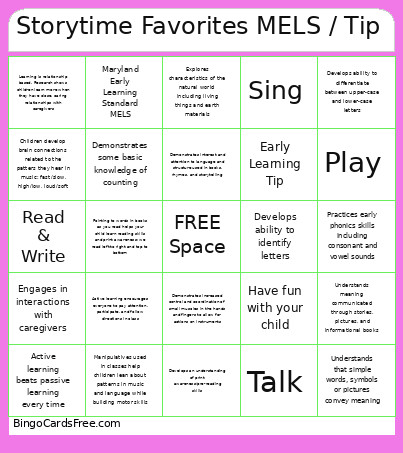
This Storytime Favorites Bingo Cards Game contains following Words or Phrases: Develops ability to differentiate between upper-case and lower-case letters, Practices early phonics skills including consonant and vowel sounds, Develops ability to identify letters, Develops an understanding of print awareness/pre-reading skills, Demonstrates some basic knowledge of counting, Demonstrates interest and attention to language and structure used in books, rhymes, and storytelling, Explores characteristics of the natural world including living things and earth materials, Demonstrates increased control and coordination of small muscles in the hands and fingers to allow for actions on instruments, Understands meaning communicated through stories, pictures, and informational books, Engages in interactions with caregivers, Understands that simple words, symbols or pictures convey meaning, Active learning beats passive learning every time, Have fun with your child, Manipulatives used in classes help children lean about patterns in music and language while building motor skills, Children develop brain connections related to the patters they hear in music: fast/slow, high/low, loud/soft, Learning is relationship based. Research shows children learn more when they have close, caring relationships with caregivers, Talk, Sing, Read & Write, Early Learning Tip, Play, Pointing to words in books as you read helps your child learn reading skills and print awareness; we read left to right and top to bottom, Active learning encourages everyone to pay attention, participate, and follow directions in class, Maryland Early Learning Standard MELS.

 This Storytime Favorites Bingo Cards Game contains following Words or Phrases: Develops ability to differentiate between upper-case and lower-case letters, Practices early phonics skills including consonant and vowel sounds, Develops ability to identify letters, Develops an understanding of print awareness/pre-reading skills, Demonstrates some basic knowledge of counting, Demonstrates interest and attention to language and structure used in books, rhymes, and storytelling, Explores characteristics of the natural world including living things and earth materials, Demonstrates increased control and coordination of small muscles in the hands and fingers to allow for actions on instruments, Understands meaning communicated through stories, pictures, and informational books, Engages in interactions with caregivers, Understands that simple words, symbols or pictures convey meaning, Active learning beats passive learning every time, Have fun with your child, Manipulatives used in classes help children lean about patterns in music and language while building motor skills, Children develop brain connections related to the patters they hear in music: fast/slow, high/low, loud/soft, Learning is relationship based. Research shows children learn more when they have close, caring relationships with caregivers, Talk, Sing, Read & Write, Early Learning Tip, Play, Pointing to words in books as you read helps your child learn reading skills and print awareness; we read left to right and top to bottom, Active learning encourages everyone to pay attention, participate, and follow directions in class, Maryland Early Learning Standard MELS.