
SIKOLOHIYANG PILIPINO Bingo Cards - Print Free or Customize
Print free SIKOLOHIYANG PILIPINO bingo cards or personalize, unlimited cards! Choose from 43,000+ templates or use the bingo card generator. Add numbers, words, photos, or all of them. Play using printed PDF, digital bingo cards, and the digital bingo caller, or go hybrid.
About: This bingo card is all about uniquely Filipino habits, attitudes, and daily moments that many will recognize with a knowing smile. Perfect for family reunions, cultural events, or bonding sessions with friends, it captures the humor, warmth, and quirks that define Pinoy life. Players can expect plenty of laughs and shared stories while celebrating their shared identity.
How To: To save a PDF to print, click the Print button. You can modify the number of cards and other print options on the Print tab. Grid items and free space text can be edited on the Basic tab. Appearance can be fully customized on the corresponding tabs, or you can quickly find any preference on the 🔍 tab.
How to play SIKOLOHIYANG PILIPINO Bingo Cards?
- Online Players: Click on the Play button above, and then click on the 🎫 button.
- Online Caller: Click on the Play button above.
- Paper Caller: Print PDF calling list & calling slips and physically choose the slips.
- Paper Players: Print PDF bingo cards and physically write on the cards.
- Mixed Mode: Choose any combination above. For example, caller can be either Printed or Online. And players can be Printed or Online or a combination of both.
Step-By-Step:
- Start by saving the SIKOLOHIYANG PILIPINO PDF by clicking on the "Print" button above.
- Open the PDF and print a hard copy.
- For random drawing, you can print another copy of the call list, cut, fold and then pull them randomly at play time.
- Cut the bingo cards at the cut marks if there are greater than 1 bingo cards per page.
- Distribute one card per player. For marking, you can use crayons. Crayons are the cheapest.
- Choose one person to be the caller. If you are playing in a small group, the caller may also play along with their own Bingo card.
- The caller begins the play by randomly pulling an item from the call list and calling out it to all players.
- The players check their cards to see if they have the announced word. If they do, they dab that word.
- The first player to finish a horizontal, vertical, or a diagonal line of crossed items announces "Bingo!" and wins the game.
- The caller validates that the items marked form a correct line as per the Bingo card and call list.
- You can play for varied patterns or a full card blackout for an extended game.
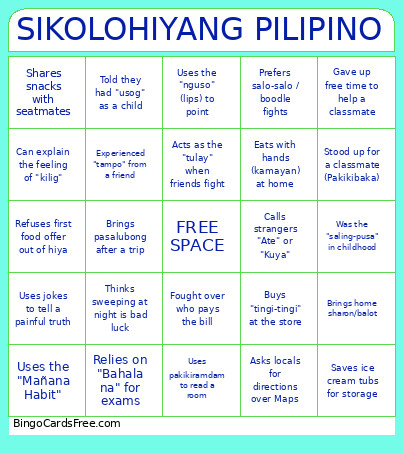 This SIKOLOHIYANG PILIPINO Bingo Cards Game contains following Words or Phrases: Guessed a friend's problem silently, Thinks sweeping at night is bad luck, Relies on "kutob" (gut feeling), Fought over who pays the bill, Uses a heavy sigh to show annoyance, Knows pakikitungo vs pakikiisa, Calls their friend group a "barkada", Has participated in Bayanihan, Says "Tabi-tabi po" near dark trees, Knows the "laway sa tiyan" remedy, Got a favor through "paglalambing", Sings karaoke as stress relief, Guilty of using "Filipino Time", Treats best friends as "Hindi Ibang Tao", Told they had "usog" as a child, Knows difference between awa & damay, Believes in Pasma or Usog, Knows the local sari-sari owner, Commutes using 3+ transport types, Prefers OPM over foreign music, Avoids stepping over people, Prefers salo-salo / boodle fights, Gave up free time to help a classmate, Visited a manghihilot/albularyo, Leaves the last piece of food on plate, Made a "panata" to pass an exam, Initiated an "ambagan" for a friend, Uses the "nguso" (lips) to point, Brings home sharon/balot, Uses eyebrows to greet someone, Refuses first food offer out of hiya, Felt "utang na loob" to a mentor, Has a "suki" they always go to, Practices pagmamano at reunions, Has more than 5 Ninongs/Ninangs, Shared an umbrella with a stranger, Can explain the feeling of "kilig", Says "po" and "opo" to siblings, Follows a strict "pamahiin", Felt immense "ginhawa" after venting, Stood up for a classmate (Pakikibaka), Treats cousins like own siblings, Avoids washing hands after work, Uses "we/tayo" for personal wins, Calls strangers "Ate" or "Kuya", Posted a "parinig" online, Acts as the "tulay" when friends fight, Names 3 local indigenous groups, Says "Kahit ano" but has a preference, Took a selfie during a flood/typhoon, Knows what "Sumpong" looks like, Asks locals for directions over Maps, Experienced "tampo" from a friend, Grew up sharing a bedroom, Felt "hiya" when offered food, Uses jokes to tell a painful truth, Says "Baka" when they mean No, Shares snacks with seatmates, Relies on "Bahala na" for exams, Joined an outing just to get along, Brings pasalubong after a trip, Lost "gana" due to a bad environment, Knows V. Enriquez founded SP, Saves ice cream tubs for storage, Uses the "Mañana Habit", Buys "tingi-tingi" at the store, Remained quiet for group harmony, Uses pakikiramdam to read a room, Fixed item with tape/wire (Diskarte), Listens to "hugot" songs when sad, Eats with hands (kamayan) at home, Asks "Kumain ka na ba?" as greeting, Calls friends' parents Tito/Tita, Was the "saling-pusa" in childhood, Shown "lakas ng loob" recently.